Description
🩸 Seamaty SD1080: Laboratory-grade biochemistry accuracy, 6 times faster!
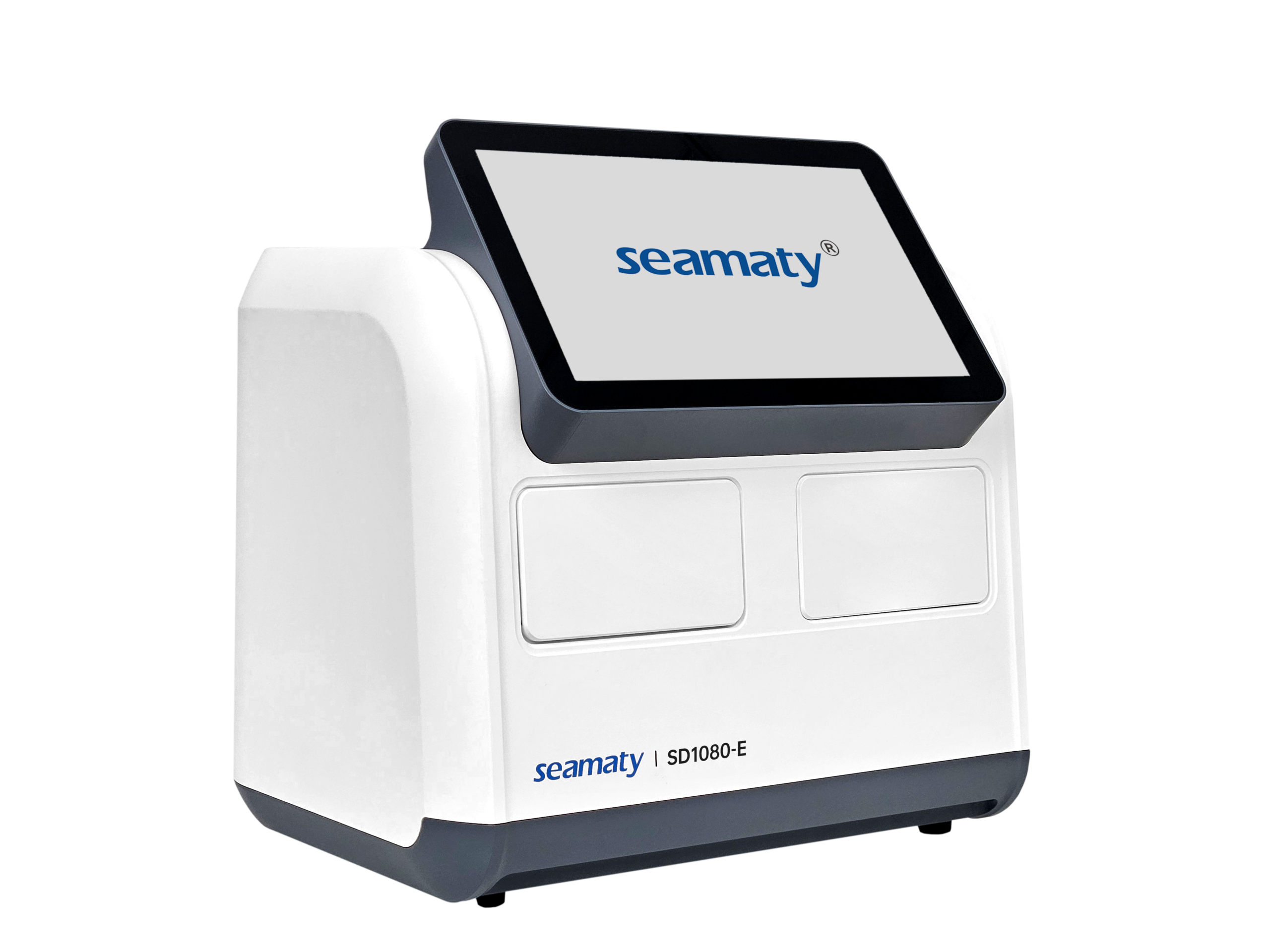
Seamaty SD1080 Automatic Microfluidic Biochemical Analyser — is a revolutionary solution for medical centres, laboratories and point-of-care testing (POCT), enabling the simultaneous testing of up to 6 samples in just 6 minutes. No more queues, complicated manual processes or long waits for results.
Modernise your diagnostics and optimise your costs. Get in touch with us, to get a personalised calculation of the cost price per test for your clinic!
🔬 Clinical and technological advantages
- Dual-channel optical system (Dual Channel Design): The analyser’s integrated architecture supports the parallel running of tests on two independent channels (Biochemistry I and Biochemistry II), which is critical in settings with a high patient throughput.
- Microvolumes of biomaterial: The optimised optical-mechanical system allows a full range of tests to be carried out using a minimal sample volume (from 50–70 µl for a sector rotor to 90–120 µl for a round rotor). This minimises the invasive burden in paediatrics and geriatrics.
- No fluid system (Maintenance Free): Dry biochemistry technology eliminates the need for internal piping, pumps, valves and rinse solutions. This completely eliminates the risk of equipment failure and removes the need for daily maintenance by engineers.
- Zero risk of cross-contamination: The use of sealed, single-use cartridges (reagent discs) with individual microfluidic channels ensures epidemiological safety and prevents cross-contamination of samples.
- Automated quality control (Smart QC & Calibrate): The system reads the built-in two-dimensional QR code on the rotor in real time, automatically calibrates the analyser and carries out internal quality control of the optics and reagents during each measurement.
⚙️ Full technical specifications for the Seamaty SD1080
| Product model: | Fully automated SD1080 microfluidic dry chemistry analyser |
|---|---|
| Sample type: | Whole blood, serum, plasma |
| Sample volume: | Round rotor, 90–120 µl 300 µl coagulation rotor 50–70 µl sector rotor |
| Test channel: | Biochemistry I and Biochemistry II |
| Resolution: | 0.001 abs |
| Terms and conditions: | Temperature: 10–30℃ Humidity: ≤85% |
| Quality control and calibration: | Automatically and in real time |
| Rated power: | 120 VA |
| Testing time: | 9–12 minutes / 3 samples |
| Temperature: | 37 °C ± 0.3 °C |
| Display: | 9.0 inches, 1024×600 |
| Connectors: | 4 USB ports, 1 LAN interface |
| Storage: | MAXIMUM 500,000 results |
| Light source: | Service life of a halogen tungsten lamp amounts to over 2,500 hours |
| Testing method: | End point, kinetic, two-point |
| Weight: | 5.88 kg |
📊 Available test profiles (Reagent panels)
The analyser supports multi-parameter discs for comprehensive screening:
- General biochemical profile (including total protein, albumin, glucose and urea).
- Liver profile (ALT, AST, ALP, GGT, TBIL, DBIL, etc.).
- Renal profile (CREA, UREA, UA, CO₂).
- Electrolytic panel (K+, Na+, Cl-, Ca2+, Mg2+, PHOS).
- Cardiovascular and lipid profiles (CK, LDH, CHO, TG, HDL, LDL).
🏥 Integration into a healthcare organisation’s workflow
- Loading of a native or diluted sample into the rotor (whole blood centrifugation takes place directly inside the instrument).
- Loading the cartridge into the dual-channel slot with automatic reading of the calibration matrices.
- Photometric detection and calculation of indicator concentrations.
- Automatic export of reports to a built-in thermal printer or directly to the hospital’s medical information system.
Simple 4-step control

Step 1
Add a sample

Step 2
Position the rotor

Step 3
Insert the rotor

Step 4
Reading results
A wide range of chemical panels to expand your on-site diagnostic capabilities.
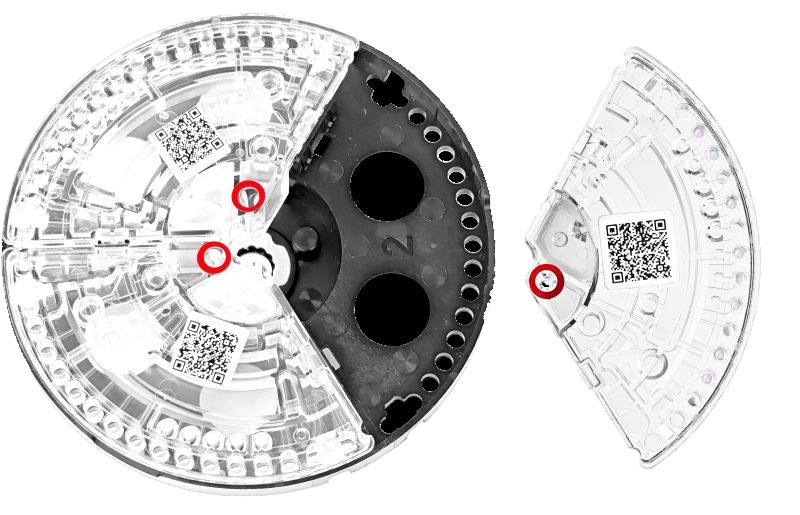
The shelf life of the reagent disc is 12 months (when stored at a temperature of 2–8 °C). The solvent is contained within the disc. The QR code contains key information about the disc.